
The First Question Every New Leader Gets Wrong
4/28/2026
Victor Petrov had done everything right.
Two degrees. One in systems engineering from Moscow State Technical University, another in business administration from a program in St. Petersburg that accepted fewer than forty students a year. His work history read like a case study in precision and performance. When Clearflow Solutions, a mid-sized firm out of Denver specializing in municipal water infrastructure, came recruiting, they didn't hesitate. Neither did he.
Six months later, Victor sat in a conference room in Denver, leading a team of eleven people, and felt completely lost.
Not technically. Never technically. The systems made sense. The processes were clear. He could dissect the operational structure of his department in his sleep. But the people, his people, felt like a language he couldn't quite speak. His team was polite but distant. Meetings were productive but flat. Something was off, and no amount of credentials could help him name it.
The Napkin That Started Everything
Isaac had met Victor at an industry event a few months earlier and stayed loosely in touch. When Victor mentioned over text that he was struggling to find his footing as a manager, Isaac didn't offer advice. He made an introduction to Kristen, a member of the Unleashing Leaders team. They met at a coffee shop near Victor's office. No agenda, just a conversation.
Victor expected advice. What he got instead was a question.
"Before you talk about your team," she said, sliding a napkin across the table, "can you draw me who you actually work for?"
Victor paused. He thought about his direct manager, his team, maybe the executive above him. He started to sketch something linear, a typical org chart.
She shook her head. "Not your org chart. Your community."
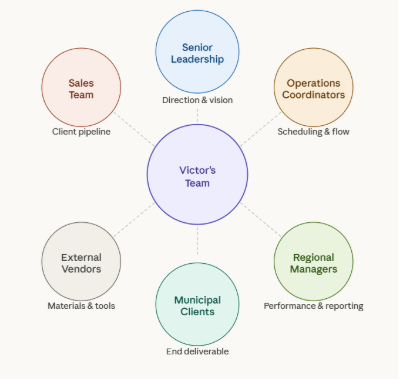
That word landed differently than he expected. She explained the concept: a Community Map is a picture of every person, group, or organization that your work touches and that touches yours. Not just the people above and below you on a chart, but everyone in your orbit. Your team. Your peers. Your internal customers. The people your customers serve. The vendors who make your work possible. The leadership above you. The world outside the walls.
She drew a circle in the center and labeled it Victor's Team. Then she began placing circles around it, one by one, asking him to name who belonged in each ring.
Within twenty minutes, Victor had filled an entire page.
What the Map Revealed
What struck Victor wasn't the size of the map. It was what it forced him to sit with.
For each group he identified, she walked him through four questions: What service do we provide them? What benefit do they get when we do it well? What do they actually want from us, not what we assume they want? And honestly, how satisfied are they right now?
That last question was the one that stung.
Victor had been so focused on delivering technical excellence that he had never stopped to ask whether his team's work was landing the way it needed to for the people depending on it. His internal customers, the sales team, the operations coordinators, the regional managers, needed speed and communication. Victor had been giving them accuracy and silence. Both valuable. But only one of them was what they actually needed most.
"I've been solving the wrong problem," he said.
She nodded. "Most new leaders do. Not because they're bad leaders. Because no one gave them a map."
Why This Is the First Step, Not a Side Activity
It would be easy to look at a Community Map and see just another workshop exercise, something you do at an offsite and forget by Monday. Victor almost made that mistake. But the more he sat with it, the more he understood what it actually was.
A Community Map is the foundation of strategy.
Real strategy, the kind that shows up in mission statements, goals, and the daily decisions your team makes, doesn't start with a vision on a whiteboard. It starts with clarity about who you exist to serve and what they actually need from you. Without that, vision becomes decoration. Goals become guesswork.
The Anatomy of Strategy is built on a base of people, roles, and behaviors. Community mapping is how you identify that base. It connects the human layer, who's in your world, what they need, how you're actually doing, to everything that sits above it: the services you offer, the strategies you set, and the mission you're working toward.
For Victor, it wasn't an abstract leadership concept. It was the missing first chapter.
The Question He Couldn't Stop Thinking About
Walking back to his office that afternoon, Victor kept turning something over in his mind.
What if his whole team did this?
Not just for their own roles, but together, as a department. What if they mapped their community as a unit, named their stakeholders honestly, rated their satisfaction without flinching, and asked the question nobody had asked yet: who are we actually here for, and are we showing up for them?
He didn't have the answer. But for the first time in six months, he felt like he was finally asking the right question.
And sometimes, that's exactly where leadership begins.
_________
The Community Map is one of the foundational tools we use with leaders at every level. If you're stepping into a new leadership role, or leading a team that feels misaligned, this is often the first place to start.
Ready to unleash your leadership?
Discover how our large-scale Strategic Planning and Operational Management Services can transform your organization, dive into practical growth with Unleashing Leaders University and get inspired by real stories on The Unleashing Leaders Podcast.